Relationship Mechanics Explained in Summertime Saga
Most frustration in Summertime Saga comes from one misunderstanding: players treat routes like linear story chapters when they’re actually interlocking progression systems. A route doesn’t advance because you like a character — it advances because you’ve satisfied a combination of stat thresholds, visited the right location at the right time, and triggered the prerequisite event chains in the correct order.
Short Answer: Relationship progression in Summertime Saga depends on stat thresholds, time-specific events, location triggers, and hidden route dependencies — not a visible affection meter.
This article explains how the relationship system actually works at a mechanical level: what drives progression, what gates it, and why the most common failure modes happen.
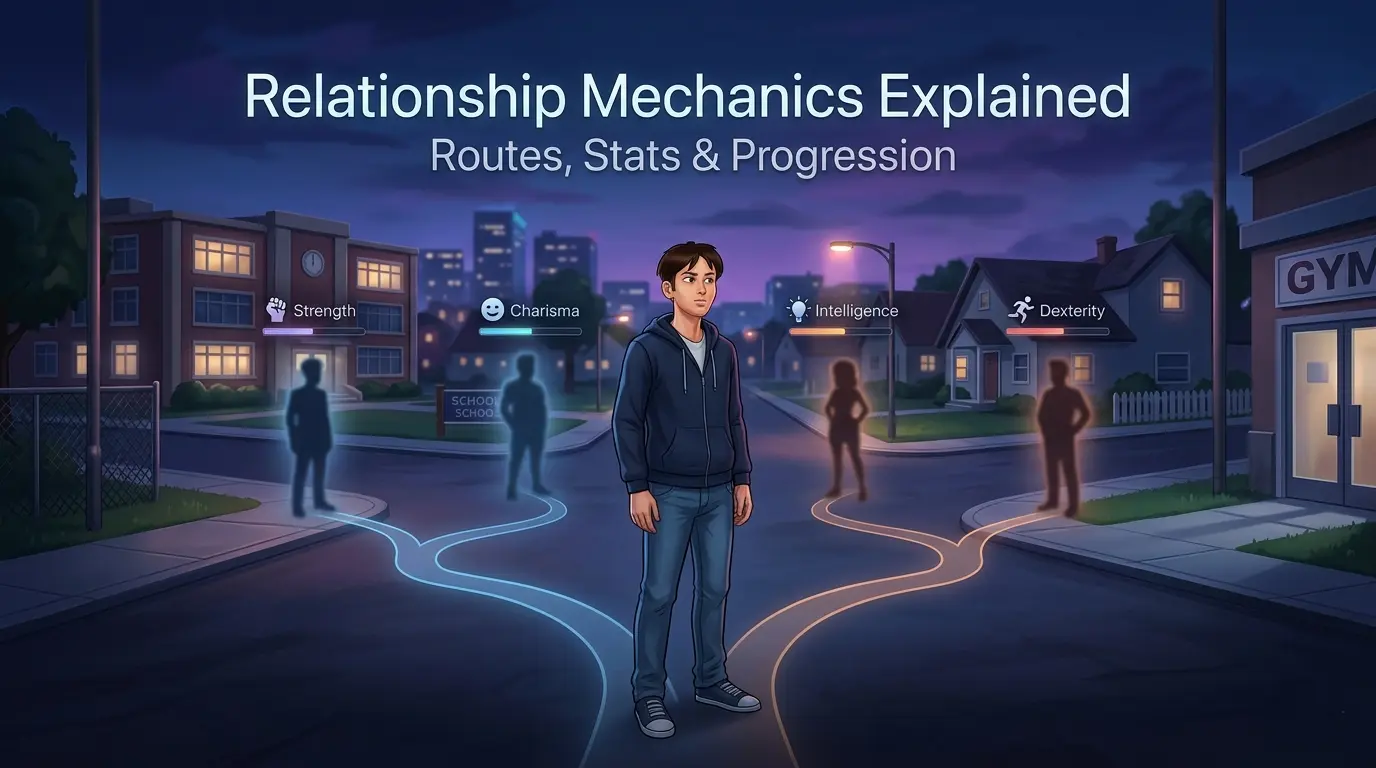
How Relationship Progression Actually Works
Progression in Summertime Saga is checkpoint-based — each route is a sequence of discrete events, and each event only becomes available once its specific prerequisites are satisfied. Once an event triggers and resolves, it sets a progression state that unlocks the next event in that character’s chain. Miss a step or fail to trigger it at the right time, and the chain stops.
This structure has a few implications that aren’t obvious at first:
- Revisiting matters. Many events only trigger when you return to a location after a previous interaction has resolved. Visiting once and leaving doesn’t complete the step — you often need to leave, let in-game time pass, and return. Players who visit a location, find nothing new, and don’t come back are the most common case of a “stuck” route.
- Conversation sequences are ordered. Most characters have a set of dialogue interactions that must happen in sequence before a route advances. Clicking through quickly or skipping interactions can sometimes cause the game to register a step as incomplete, particularly if a branching choice is involved.
- Some events are location-specific within a character’s broader map. A character you interact with at school might have a separate event that only triggers at their home, or at a specific sub-area within a location. Interacting at one location doesn’t substitute for the interaction the route is looking for elsewhere.
- Event chains can span multiple in-game days. A character won’t always have a new interaction available every visit. Some chains deliberately require multiple separate visits across different time blocks before the next step unlocks — this is intentional pacing, not a bug.
Each character route is a series of story checkpoints with entry requirements. Clear the requirement, the checkpoint fires, and a new one becomes active. If new content isn’t appearing, the issue is usually a missing stat, time-of-day requirement, or unfinished dependency elsewhere in the game. Recent changes in the WIP 7712 update also refined how some progression states are handled behind the scenes, helping reduce route conflicts and stalled events.
Affection and Route Progression
Summertime Saga doesn’t use a transparent affection point system — there’s no number counting up in the background that fills to a threshold and unlocks a scene. Progression is entirely event-driven: the game checks whether specific route conditions have been met, not whether a relationship score has crossed a value.
What this means practically:
- You can’t “grind” a relationship by repeatedly talking to a character. If the next event requires a stat gate or a separate location visit, talking more at the current location won’t advance anything — you’ll keep getting the same dialogue until the requirement is satisfied.
- There’s no way to “bank” progress by spending extra time with a character. Either the event requirement is met and the next step fires, or it isn’t and nothing moves.
- Some characters share prerequisite chains — meaning you need to advance a separate character’s route before a progression trigger is set that unlocks progress on the character you’re actually focused on. These cross-route dependencies are one of the more unintuitive parts of the system.
- Erik’s storyline is one of the clearest examples of this design. Players often think his route is bugged when the real issue is a dependency elsewhere in the household. Our Erik character guide breaks down the most common progression blockers and why they happen.
- One example is the farm storyline, where progression can feel stalled even when you’re repeatedly visiting the correct location. Players following farm-related content often run into stat requirements, timing restrictions, or dependency conditions that aren’t immediately obvious. Our Diane guide breaks down the most common progression blockers and how the farm route actually works.
The progression model is closer to an adventure game’s trigger system than a dating sim’s affection counter. Understanding that distinction changes how you approach getting stuck — instead of asking “how do I improve my relationship,” the right question is “what event requirement is the next step waiting on?”
How Stats Affect Romance Routes
Stats are the most common hard gate on route progression. Unlike dialogue interactions, which resolve through visiting and engaging, stats require deliberate investment to build — and unlike most other requirements, they’re invisible to players who aren’t specifically looking for them.
A lot of players spend several in-game days revisiting the same character repeatedly without realising the actual blocker is a stat requirement or a missed nighttime trigger elsewhere on the map. There’s no error message and no indication of what’s missing — the route simply doesn’t advance until the condition is met.
The four stats that most frequently block route progression:
One of the most broadly required stats across multiple routes. Built at the gym through the workout minigame. Several characters — particularly those with routes involving physical confrontation, athletic contexts, or specific action-oriented scenes — have Strength checks that silently block their next event.
📍 Build location: Gym — workout minigameGates events involving persuasion, social interaction, or winning a character’s trust through conversation. Routes with initially resistant or guarded characters tend to have Charisma checks at key points. Built primarily through the drama class at school.
📍 Build location: Drama class at schoolRequired for routes involving academic contexts, problem-solving, or characters who respond to intellectual competence. Built through attending class and visiting the library. One of the more naturally-built stats for players who keep up with school attendance.
📍 Build location: School class + libraryThe least commonly required stat but relevant for specific routes and minigames. Gates events involving fine motor tasks, crafting contexts, or particular scene types. Players who reach routes requiring it without having built it face an unexpected backtrack.
📍 Relevant for specific route typesThe Core Problem
Stat requirements aren’t announced before you encounter them. The game doesn’t display “this event requires Strength 4” — the event is simply unavailable, looking identical to a location where nothing is currently active. Building all four stats proactively from early game is far more efficient than reactive catch-up when a specific route stalls.
Time-of-Day Mechanics and Their Effect on Progression
The time system operates in distinct blocks — morning, afternoon, evening, and night — and character availability, location access, and event triggers are all tied to specific windows. The game doesn’t pause progression while you’re idle; time advances through actions and time-skip choices.
Character Schedules
Characters follow location patterns based on time of day. A character available at school in the morning won’t be there in the afternoon. A character accessible at home in the evening may have route-specific events only available in a sub-block of that window.
If you show up outside their active time, you get no interaction — and it’s easy to read that as “there’s nothing new” rather than “I’m here at the wrong time.” The most common version: a player visits a character, gets a placeholder interaction, and concludes the route is complete. In many cases the next step exists — just at a different time block.
Night-Only Events
Several route events are only available at night. These are disproportionately missed by players who time-skip to morning each day to maximise school and gym attendance.
Night isn’t a downtime period in the progression system — it’s an active event window for specific characters and locations. Players who habitually skip past night are systematically skipping a meaningful subset of route content.
Time-Block Specificity
Some events are available during “evening” broadly, while others are locked to a narrower window within that block. If an expected interaction isn’t triggering in what feels like the right time, experimenting with arriving at different points within that block can surface interactions that seemed unavailable.
Day-of-Week Restrictions
School-based events and characters are unavailable on weekends by design. For routes heavily tied to school, progression is capped by the number of available school-day morning blocks — there’s no catching up on missed school interactions over the weekend.
Common Reasons Routes Stop Progressing
When a route stops advancing, the cause is almost always one of these:
Right location, right character, wrong time. Produces nothing — looks identical to “route complete” or “route bugged.” Check the character’s schedule and try different time blocks before assuming progression is stuck.
A stat gate is silently blocking the next event. No indicator. If a route has been correctly navigated — right location, right time, prior steps done — but still won’t move, a stat check is the most likely cause. Build all four stats regularly rather than reactively.
An earlier step wasn’t fully resolved — a conversation exited early, a minigame failed without retry, or an interaction was approached at a location that triggered a placeholder rather than the actual progression event.
Some events require interaction with a specific object, area, or secondary character within a location — not just the primary character. Players who don’t explore sub-areas miss these triggers consistently.
A route condition in character A’s chain requires a progression trigger set by character B’s route. If B hasn’t reached that point yet, A is blocked regardless of everything else. The route sequencing guide covers which routes have dependency relationships worth planning around.
Some events have item prerequisites — a gift, a purchased item from the mall, or a crafted object. The event won’t fire without it. Less common than stat gates but easy to miss if inventory isn’t being tracked during an active route phase.
Some route branches only open after a specific initiating interaction — often an early conversation that sets the condition opening the rest of the chain. If that initial interaction was missed, nothing downstream becomes accessible. Return to the character’s starting location and check for unresolved initial dialogue.
How Multiple Routes Interact With Each Other
Running multiple routes simultaneously is possible — but has real implications for how time gets distributed and how dependencies play out.
Schedule Conflicts
Characters with overlapping time-block availability compete for limited in-game time. Morning is the most constrained period — school attendance, gym visits, and morning-specific character interactions all want the same window.
Players who try to advance every route simultaneously often find none of them moving efficiently because morning is being spread too thin. Prioritising two or three active routes while keeping others in a slower-build phase works better than even distribution across all characters.
Dependency Sequencing
Running routes in an order that satisfies cross-route dependencies earlier makes later routes significantly smoother. Some routes function as soft prerequisites for others — not because the game enforces an order, but because dependency conditions won’t be set until those routes reach a certain point.
Advancing dependent routes early prevents later routes from hitting invisible walls mid-chain.
Stat Investment Alignment
If multiple active routes share the same stat requirement, investment serves double duty. If active routes require conflicting stat priorities, there’s an opportunity cost to building one over the other. Choosing routes with aligned stat requirements makes early-game investment more efficient and reduces separate grind sessions.
Cognitive Load
There’s a practical limit to how many active routes can be tracked without losing the thread of where each one sits. Players managing six routes simultaneously often forget where they were in each, miss time windows attending to other characters, and create a situation where everything appears stuck at once.
Plan Your Route Order Before You Play
Cross-route dependencies and stat alignment make route order one of the highest-leverage decisions in the game. See which characters work best together.
Best Early Relationship Strategy
The most common early-game mistake is treating the first few in-game days as social time — visiting characters, starting conversations, assuming that engagement is building toward something. It is, but only up to the first checkpoint. After that, what moves routes forward is stat investment, not additional conversation.
- 1Attend school every available morning. Builds Intelligence passively, keeps school-based route chains active, and introduces key characters. Missing school days creates cumulative gaps that slow multiple routes at once.
- 2Start gym visits immediately. Strength is the most broadly required stat. Starting from day one means it’s available when needed rather than requiring a mid-route catch-up grind.
- 3Establish the income loop early. Many route events require purchased items or gifts. Running the income-generating computer interaction from the start means resources are available when routes demand them.
- 4Map character time blocks early. In the first few days, visit each accessible character at different times to understand their schedule. This investment eliminates wasted visits throughout the playthrough.
- 5Don’t over-commit to one route too early. Routes requiring other routes as prerequisites will stall if dependent characters are ignored entirely. Maintaining some progress across multiple routes ensures dependency conditions get set before they become blocking issues.
Hidden Progression Triggers Players Miss
Some of the most important progression steps are triggered by interactions that don’t look like progression steps. These are the ones that cause routes to appear stuck when they’re actually one missed interaction away from advancing:
Leaving a location and re-entering after a certain condition is met can fire an event that didn’t trigger on the initial visit. Some events are structured as “next time you enter this location after X” — not “available when you visit.” Players who exhaust a location’s interactions and stop returning miss these entirely.
Some route events require interacting with a character other than the one you’re pursuing. A conversation with a side character, a parent, or a friend can set a progression state that unlocks the next step in a completely separate route. These are discovered by engaging with the world broadly rather than tunnel-visioning on specific characters.
Certain route triggers live on objects, furniture, or environmental elements — not on characters. The home computer, specific room items, and certain outdoor interaction points all have conditions that initiate event chains. The hidden interaction guide covers several of these in detail.
Some conversations include branching choices where the selected option affects whether a progression state is set correctly. In most cases both options lead to the same place eventually — but in a handful of interactions, the wrong choice leaves a condition unset and the route stalls at the next visit.
Several characters have interactions available exclusively at night that don’t correspond to their daytime presence at the same location. Visiting at night when you’ve previously only visited during the day sometimes surfaces entirely new interactions with characters you thought were fully explored.
Why Some Events Feel “Locked” or Unavailable
The event dependency system means some route content is genuinely inaccessible until multiple separate conditions are met — sometimes spread across different characters, stats, locations, and time blocks. This creates situations where a player has done “everything right” in their immediate route focus but is blocked by a dependency they haven’t tracked.
Stat + Condition Combination Locks
Some events require both a stat threshold and a specific route condition to be set. Meeting one without the other produces nothing. A player with the required Charisma but missing the prerequisite dialogue condition — or vice versa — hits the same invisible wall. Troubleshooting requires checking both dimensions.
Third-Party Condition Requirements
An event in route A requires a condition set by route B. Route B’s condition won’t be set until a specific point in its own chain. If route B is running in parallel but hasn’t reached that point, route A is locked regardless of everything else.
This is the most opaque dependency type and the hardest to resolve without understanding the broader route structure. It’s why knowing the general progression relationships between characters matters for efficient play.
Sequence Breaks
Occasionally a player reaches a character in an unusual order and triggers interactions out of sequence. When this happens, an earlier condition that should have been set may be missing, causing a later event to never unlock. The solution is returning to the earliest point in the chain and working forward — which requires knowing where the chain begins.
Time-Locked Event Windows
Some events are only available during a specific phase of a route and can’t be triggered once that window has passed. These are rare but exist — certain early-game interactions that set up later scenes, or transitional events between major route phases, can be missed if the condition window closes.
This is the closest the game gets to truly missable content within routes. For a catalogue of these, the missable event reference is worth checking alongside this guide.
Balancing Exploration and Route Progression
Broad world exploration and focused route progression aren’t in opposition — they support each other. Players who explore freely tend to set dependency conditions organically. Players who tunnel-vision on single routes hit walls that broader exploration would have resolved.
A few habits that keep both moving:
- Run a loose circuit of locations rather than camping on one. Visiting a range of areas across different time blocks naturally satisfies “visited X since last time” conditions that re-entry triggers depend on.
- Revisit locations that previously had nothing. Progression states change as routes advance. New interactions appear at locations already explored. Treating a location as fully resolved after one visit is one of the most consistent ways content gets missed.
- Pay attention to dialogue changes. When a character’s available dialogue shifts — even a single new line — that’s a signal a progression state has been set and new interactions may be available.
- Use time skips deliberately. Skipping to a specific time block for a specific character visit is efficient. Skipping nights entirely means losing an active event window every day.
For a full breakdown of which locations have time-based availability and how to navigate the world map efficiently, the location access guide maps out the full area system in detail.
Practical Summary
The relationship system rewards players who treat it as a flag-and-gate progression model rather than a social simulation. Progress doesn’t come from time spent with a character — it comes from satisfying specific conditions in the correct order.
The habits that matter most:
- Build all four stats continuously — not reactively when a route stalls
- Attend school every available morning
- Never skip nights entirely — night-only events exist and are easy to miss systematically
- Revisit locations rather than treating them as explored after one visit
- Explore broadly enough to set cross-route dependency conditions naturally
- Interact with objects and secondary characters, not just the character you’re pursuing
For players planning route order with these mechanics in mind, the route sequencing guide covers which character paths have dependency relationships and how to order them for the smoothest experience. Further resources are at the main Summertime Saga hub.
Ready to Plan Your Perfect Playthrough?
Explore the full guide library — route order, hidden scenes, location maps, and more — at the Summertime Saga hub.