Debbie Summertime Saga Guide
(Story, Route & Progression Tips)
Debbie is one of the first characters you interact with and one of the last routes most players feel like they’ve fully understood. She’s present from the opening moments of the game, her storyline runs deeper than it first appears, and her route has more progression nuance than the early household interactions suggest.
A lot of players start her route casually — she’s right there at home, so why not — and then hit unexpected walls mid-progression without understanding why. This guide covers who Debbie is, how her route is structured, what commonly blocks progress, and what to know before committing seriously to her storyline.
Quick Overview: Debbie is a central character in Summertime Saga whose storyline is closely connected to home events, overall story progression, and several important route triggers. Her route runs throughout the full game rather than resolving early, and several of its key moments depend on conditions set by other parts of the story.
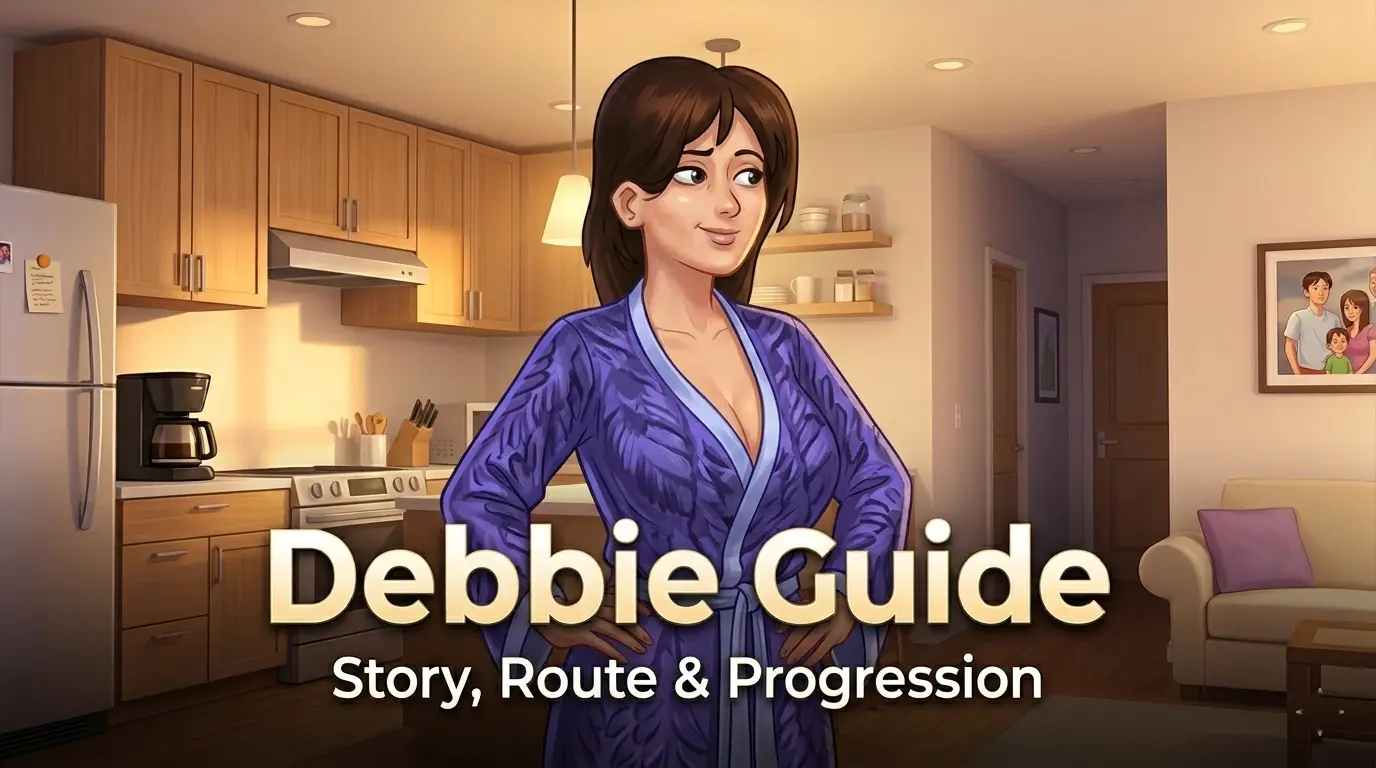
Who Is Debbie in Summertime Saga?
Debbie is Anon’s mother — the primary adult figure in the household and one of the anchoring characters in the game’s domestic setting. She manages the home, works to keep things financially stable after the family’s circumstances change at the start of the story, and is consistently present across more of the game’s timeline than most other characters.
Her personality is warm but grounded. She’s attentive to Anon without being overbearing, carries a visible weight from the family’s financial situation, and has her own life outside the household that the player gradually learns about as her route develops. She’s not a simple archetype — the writing gives her actual motivations, concerns, and a backstory that emerges through her route rather than being front-loaded in an introduction.
Within the household she serves as both a story anchor and a practical presence. Many home-based events involve her directly or reference her indirectly. Other characters’ routes occasionally intersect with the home environment in ways that touch on Debbie — she’s woven into the setting more thoroughly than most characters are to their associated locations.
Her relationship to Anon at the start of the game is straightforwardly maternal, and the route’s progression involves that dynamic evolving through a gradual series of interactions rather than a sudden shift. That gradual pacing is both one of the route’s strengths and one of the reasons players sometimes feel like nothing is advancing when they’re actually mid-progression.
Need a Full Walkthrough?
Our complete story progression guide covers every route, location, and unlock in detail.
Why Debbie’s Route Is Important
Debbie’s route isn’t a side story you can comfortably defer until everything else is complete. It’s integrated into the game’s home environment in a way that makes it relevant throughout a playthrough, not just during active pursuit.
A few reasons her route carries more weight than it initially appears:
- Home event density. More optional interactions happen at the home location than almost anywhere else in the game. Debbie is the primary character anchored there. Players who don’t engage with her route miss a significant portion of the home’s available content — not because it’s hidden, but because Debbie’s progression state controls what home interactions are active.
- Story relevance. The family’s financial situation and the circumstances around Anon’s father are core to the main story. Debbie is the primary source of information and perspective on those events. Advancing her route provides context that makes other story elements more coherent.
- Route depth relative to early impression. The first few interactions with Debbie are ordinary domestic exchanges. Players who judge the route’s depth by those early moments often underestimate how far it develops. Her storyline has multiple distinct phases that unfold over a long stretch of in-game time.
- Cross-route connections. Several other characters’ routes have interactions that occur at or around the home, and some of those interactions are gated by Debbie’s progression state. Neglecting her route can create invisible blocks in routes you’re actively pursuing.
Why Debbie Is One of the Most Popular Characters
Debbie has remained one of the most talked-about characters in Summertime Saga because she combines story relevance with consistent screen time. Unlike many characters who are tied to a specific location or storyline, Debbie is present throughout the game and remains connected to the player’s daily routine from beginning to end.
Another reason for her popularity is the depth of her storyline. What begins as a simple household relationship gradually develops into one of the game’s longest-running character arcs. Players spend a significant amount of time interacting with Debbie across multiple stages of progression, which naturally creates a stronger connection compared to shorter routes.
Her role in the family’s financial struggles and the events surrounding Anon’s father also gives her importance beyond optional route content. Even players focused primarily on the main story regularly encounter Debbie, making her one of the most recognizable and memorable characters in Summerville.
For many players, Debbie’s route represents the balance between character development and story progression. Rather than feeling disconnected from the larger narrative, her storyline remains closely tied to the events happening throughout the game world.
How To Start Debbie’s Route
Debbie’s route doesn’t have a formal “start” the way some characters do — there’s no unlock moment or map addition that signals her storyline is now active. It begins through ordinary household interaction and progresses from there.
The early phase involves spending time at home during appropriate time blocks, engaging with available household interactions, and progressing through the opening story beats that establish the family’s situation. Debbie is involved in several of those early story moments regardless of whether you’re actively pursuing her route, which means the beginning of her storyline often advances naturally through normal play.
What distinguishes passive story involvement from active route progression is consistent return to the home environment and deliberate engagement with Debbie-specific interactions when they appear. The home is accessible at most hours, but Debbie’s availability shifts across time blocks — morning, evening, and night each have different interaction states, and which interactions are available depends on how far her progression has advanced.
Early requirements are light — no significant stat gates in the opening phase, and no specific items needed to begin. The main requirement is simply that the player engages with the household and doesn’t skip past home interactions in the rush to pursue school or external routes. Players who spend their early game entirely outside the home often find Debbie’s route in an unexpectedly early state when they return to it later.
Debbie Route Requirements
Debbie’s route becomes more demanding as it progresses. The early phase is accessible, but mid-route and late-route content has a mix of conditions that can block advancement silently if they’re not tracked.
Story Progression Dependencies
Some of Debbie’s route events are gated by the main story’s progress rather than by Debbie-specific interactions. Certain scenes won’t trigger until particular story beats have occurred elsewhere in the game. This is one of the less obvious blocking conditions — players who have engaged with Debbie regularly but hit a wall may be waiting on a story event that’s actually located in a completely different part of the game.
Time-Based Availability
Debbie’s interaction states change across time blocks. Morning, evening, and night each surface different content depending on her current progression level. Several of her route’s more significant interactions are specifically tied to evening or night visits — players who primarily interact with her in the morning see a much smaller slice of what’s available. This is a consistent source of players feeling like her route has stopped when it actually has active content waiting at a different time of day.
Home Sub-Area Interactions
Not all of Debbie’s route plays out through direct character interaction. Some progression steps involve interacting with specific areas or objects within the home — the kitchen, particular rooms, environmental triggers — rather than clicking on Debbie directly. Players who only engage with her as a character and don’t explore home sub-areas miss some of these steps.
Route Pacing Requirements
Some steps in Debbie’s chain require in-game time to pass between visits — returning immediately after an interaction won’t advance things further. The route is designed with a natural pacing rhythm that rewards regular visits over consecutive sessions rather than attempting to exhaust all available content in a single sitting.
Common Reasons Debbie’s Route Stops Progressing
Debbie’s route has a higher-than-average rate of players getting stuck mid-chain. Most of the time the cause is one of a small number of recurring patterns:
Visiting at the Wrong Time of Day
This is the single most common cause. A player checks in with Debbie in the morning, finds nothing new, and concludes the route is stalled. Evening and night interactions are frequently where the next step lives. If morning visits are consistently producing nothing, try the same location at evening and night before assuming the route isn’t progressing.
Quick Fix: Before concluding Debbie’s route is stuck, always check evening and night interactions at the home location — this resolves the majority of reported stalls without any other changes needed.
A Main Story Event Hasn’t Triggered Yet
Some of Debbie’s route events won’t unlock until specific main story beats have occurred. If her route has been correctly navigated — right time, right location, prior steps completed — but nothing new appears, an outstanding main story event elsewhere in the game may be the actual blocker. Advancing the main story and then returning to Debbie often resolves this.
A Home Sub-Area Interaction Was Skipped
Players focused on character-to-character interaction often miss interactions tied to specific areas of the home. A step that requires visiting a particular room or engaging with a specific household object can block the entire downstream chain if skipped. Going back through the home environment and checking areas that haven’t been interacted with recently often surfaces the missed trigger.
The Route Pacing Interval Hasn’t Elapsed
Some steps explicitly require time to pass in-game before they become available again. Revisiting immediately after an interaction resolves won’t produce the next step — a day or more of in-game time may need to pass. This is intentional pacing and not a bug, but it’s easy to mistake for a stall when you’re in a productive session and expecting continuous advancement.
A Cross-Route Dependency Is Unmet
Certain events in Debbie’s route are connected to other characters’ storylines. If a relevant character’s route hasn’t reached the required point, Debbie’s chain won’t advance past that gate regardless of how much time is spent at home. Understanding the broader relationship progression systems in the game helps identify when cross-route dependencies are the actual issue rather than something specific to Debbie’s chain.
Early Interactions Were Skipped During the Opening Story
Players who rushed through the game’s opening sequence to get to external content sometimes skipped initial home interactions that set foundational progression states. If Debbie’s route feels stuck very early — even before any obvious gate — returning to check whether early household interactions were fully resolved is worth doing before anything else.
Understanding Route Mechanics
The relationship progression guide covers cross-route dependencies and how to resolve invisible blocks across the full game.
Tips for Progressing Debbie’s Storyline Efficiently
Debbie’s route responds well to a consistent presence at home rather than intensive burst visits. A few practical approaches that keep her progression moving without over-investing time:
- Check home at multiple time blocks, not just one. A morning-only home routine misses the majority of Debbie’s evening and night content. Building a habit of visiting home across at least two different time blocks per in-game day is the single most effective change for players who feel stuck.
- Don’t neglect the home environment between active sessions on her route. Even when focused on external routes, dropping by home each session to check for updated interactions takes minimal time and ensures her pacing-based steps don’t get inadvertently delayed.
- Pay attention to dialogue shifts. When Debbie’s dialogue changes — even a small new line or a slightly different response — that’s a signal that a progression state has updated and new interactions may be available. Players who skip through repeated dialogue miss these cues consistently.
- Explore home sub-areas regularly. The kitchen, specific rooms, and environmental objects in the home can hold progression triggers. A quick pass through interactable areas alongside character interaction keeps the chain moving in ways that character-only engagement doesn’t.
- Advance the main story alongside her route. Because some of Debbie’s events are gated by overall story progress, players who stall on the main storyline while trying to push her route will hit walls that can’t be resolved by anything home-specific. Keeping story progress moving maintains access to Debbie’s later content.
- Don’t expect linear daily progress. Debbie’s route has built-in intervals. Some days at home will produce nothing new, and that’s expected. The route rewards return visits over time, not consecutive-day grinding.
How Debbie Connects to Other Storylines
Debbie’s position in the household makes her route unusually well-connected to other storylines compared to characters who are anchored to external locations. A few of those connections are worth understanding:
The Family’s Financial Storyline
The debt plot that runs through the main story’s background is most directly visible through Debbie. Her route provides the most detailed perspective on how the family ended up in its current situation and what that means for Anon’s circumstances. Players who run her route alongside the main story get significantly more context on events that might otherwise feel abstract.
Other Household Characters
Characters whose routes bring them to or near the home location interact with the household environment in ways that sometimes touch on Debbie’s progression state. A few of those interactions are gated by where Debbie’s route sits — players pursuing another character’s home-adjacent events may find those events unavailable until Debbie’s route has reached a certain point.
The Main Storyline
Debbie is more connected to the main narrative thread than most optional routes. Several main story moments involve her directly, and her route’s progression influences how some of those moments play out. Running her route actively rather than treating it as purely optional gives the main story’s domestic sequences more weight and context.
For players navigating multiple active routes alongside Debbie’s, the area progression reference is useful for understanding which locations other characters are anchored to and how to manage home visits alongside external route work.
Is Debbie Required for Main Story Progression?
Debbie’s route isn’t a hard requirement in the sense that the game forces her storyline before unlocking the ending. The main story can be progressed without completing her route.
That said, the practical answer is more nuanced than a simple yes or no:
- Some main story events involve Debbie directly and will advance regardless of route progress — she’s part of the story’s structure, not just an optional addition.
- Several home-based events in other characters’ routes are connected to Debbie’s progression state, meaning neglecting her route can create invisible friction in routes you are actively pursuing.
- The main story’s domestic context — the debt, the family’s history, Anon’s home life — is significantly more coherent with Debbie’s route active. Without it, those story threads feel thinner.
The practical recommendation: treat Debbie’s route as a continuous background priority rather than something to defer entirely. Even partial progression alongside other routes keeps her chain moving and prevents the cross-route dependency issues that come from ignoring the home environment for extended periods.
Not every progression system is tied to school events or social interactions. Farm-based content follows its own structure, with stat requirements and recurring tasks playing a larger role. Our Diane route guide explains how that progression works and why players sometimes get stuck.
How Debbie Changes Throughout the Story
One reason Debbie’s storyline feels more substantial than many character routes is that her character evolves noticeably over time. Early in the game she is primarily focused on maintaining stability within the household and helping the family adjust to difficult circumstances. Her concerns are practical, and most interactions revolve around everyday responsibilities.
As the story progresses, players begin to see different sides of her personality. New conversations reveal personal worries, long-term pressures, and perspectives that were not obvious during the opening chapters. This gradual development helps Debbie feel more like a fully realised character rather than a static character in the background.
The pacing of her route also contributes to this growth. Because major events are spread across a long portion of the game, players experience her storyline in stages rather than all at once. Small changes in dialogue, behaviour, and available interactions create a sense that the character is developing alongside the broader story.
By the later phases of the game, Debbie’s role extends beyond the household routines that define her early appearances. Her storyline becomes more connected to the wider narrative, giving players a deeper understanding of both her character and the family dynamics that influence many of the game’s events.
Frequently Asked Questions
There’s no formal unlock moment. Debbie’s route begins through normal household interaction in the opening part of the game. Engaging with home events during the early story naturally initiates the first phase of her storyline without any specific trigger required.
The most common causes are visiting at the wrong time of day (evening and night content is frequently where the next step lives), a main story event that needs to trigger first, or a home sub-area interaction that was skipped. Check all three before concluding the route is stuck. The route mechanics guide has a broader troubleshooting framework for progression blocks that applies here.
Yes, more than her optional route status suggests. She’s the primary source of context on the family’s financial situation and backstory. Main story events involve her directly, and her route provides the domestic narrative thread running under the rest of the game.
Most of Debbie’s route content is available as long as you haven’t bypassed early home interactions entirely. A small number of interactions are tied to specific timing windows, but the majority of her storyline remains accessible throughout a playthrough as long as basic early steps were completed. If early home events were skipped in the rush to reach external content, some foundational steps may need to be revisited.
From the beginning, passively. There’s no reason to defer — early home interactions are light in requirements and set foundation states that later content depends on. Players who put off the home environment entirely to focus on external routes often find they’ve created unnecessary complications when they eventually return. Keeping Debbie’s progression active from the start, even at a slow pace, is better than picking it up cold mid-game.
Yes, in specific ways. Some home-adjacent events for other characters are gated by Debbie’s progression state. Neglecting her route for extended periods can create indirect blocks in other active routes — another reason to keep her chain moving as a background priority rather than fully deferring it.
Debbie’s route is one of those storylines that reveals more depth the further into it you get. The opening interactions are low-key enough that it’s easy to underestimate what the full route contains — but players who stay consistent with home visits and pay attention to the time-block system tend to find her storyline one of the more rewarding in the game.
The main practical takeaway: don’t treat the home environment as a passive backdrop. Debbie’s route lives there, and so do a number of cross-route dependencies that affect the rest of your playthrough. Regular visits at varied time blocks, attention to home sub-areas, and keeping the main story moving alongside her route is all it takes to avoid the progression walls that catch most players by surprise.
For step-by-step progression help across the full game, the complete story progression guide covers the broader route structure in detail. Further resources are at the Summertime Saga hub.